Google Put an AI Tutor Beside Coursera Lessons. Its Own Report Says Learning Didn't Move.
The optional chatbot in the sidebar is the exact version that keeps failing. The version that works is the one students can't skip.
Google published a report on AI in education this month. The most useful sentence in it is the one admitting something didn't work.
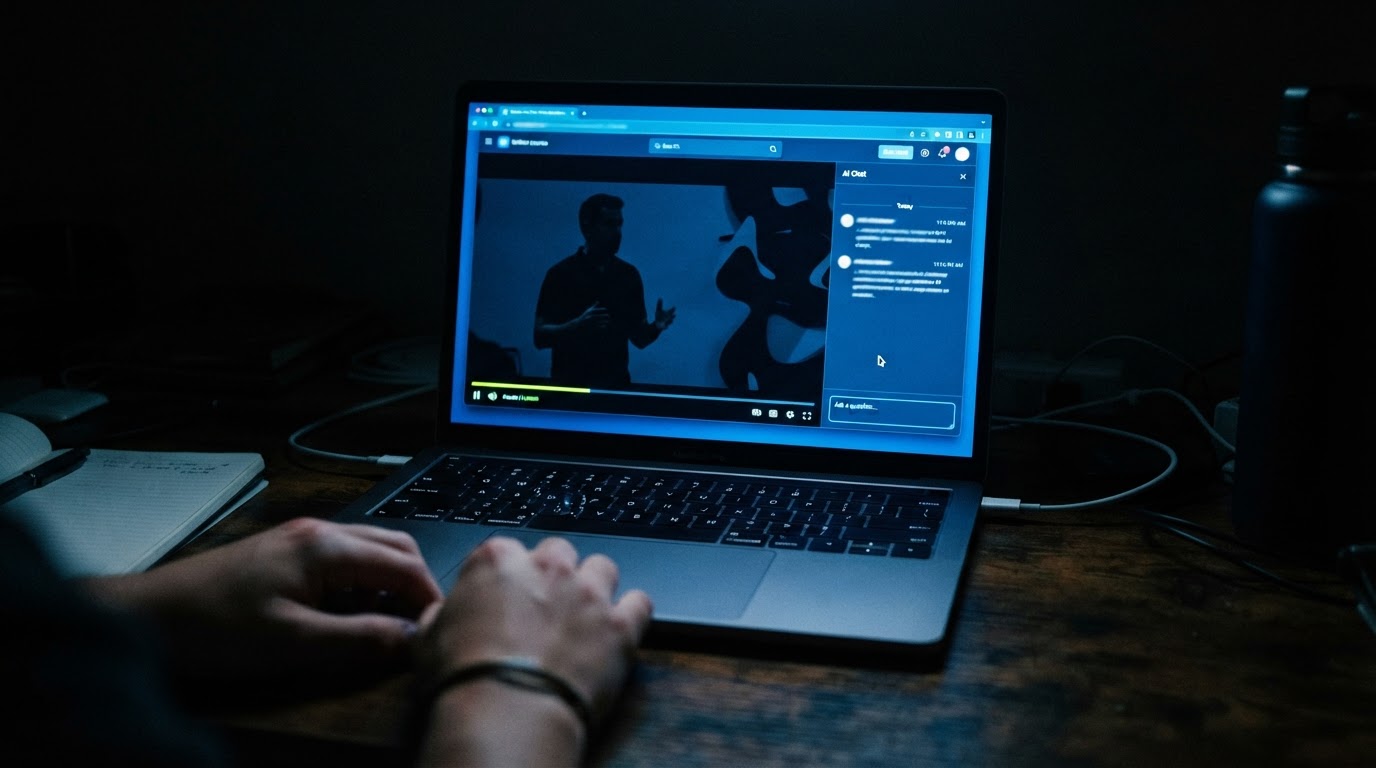
The 29-page report, titled "AI in Education: From potential to practice" and dated November 2026, lists Yossi Matias and Ben Gomes among its authors. Inside, Google writes that an optional "tutor-on-the-side" implementation of AI — first in an early pilot with ASU's Study Hall program, and more recently on Coursera — failed to yield meaningful performance gains despite being grounded in course materials.
Grounded in the actual lesson content. Sitting right next to the video. Nothing measurable.
That is the exact product being sold to course creators right now.
The reason is boring, and it's about you
It wasn't that the model was bad. It was that almost nobody used it. The report attributes the flat result mainly to low student adoption: 30% on Coursera and 39.3% in Study Hall.
Seven out of ten students on Coursera walked past the tutor.
The fix Google reports is not a better bot. It's a different instruction. Making AI tutoring an educator-prescribed part of Coursera courses nearly doubled adoption, and the report says a design where teachers determined how and when students should interact with AI resulted in statistically significant learning gains.
Same technology. Different placement in the curriculum. Opposite outcome.
What a tutor that actually works looks like
The benchmark case is not a sidebar widget. A randomized crossover trial by Greg Kestin and colleagues, published in Scientific Reports in June 2025, ran inside Harvard's largest introductory physics course in autumn 2023 with 194 students. Students using the AI tutor learned more than twice as much as those in the active-learning class, in less time — a median of roughly 49 minutes against 75 — while reporting higher engagement and motivation.
Two details matter more than the headline number. The comparison group was an active learning classroom, considered best practice in physics education. And the AI tutor was not an open-ended chatbot. The paper's authors report effect sizes of 0.73 to 1.3 standard deviations.
It was a purpose-built instructional system with pedagogy designed into it, assigned as the lesson rather than offered beside it.
The wider evidence agrees, uncomfortably
Stanford's SCALE Initiative updated its review this month. The November 2026 version adds 32 studies to its causal evidence base, bringing the total to 52, without delivering a blanket endorsement of classroom AI.
Its read on what separates the wins from the duds is precise. AI looks more promising when students use it to explain concepts, guide practice, or get feedback on their own work than when they use it to generate answers or complete work for them — but learning gains are not consistent even when AI is used for learning support. The review also notes the evidence does not yet show whether gains persist over longer periods.
Chalkbeat's summary of the review was blunter: even where students reported positive experiences, the evidence of learning gains was mixed.
Translation for your course
If your AI assistant is a floating button students may or may not click, you are shipping the condition that produced no gains in two separate Google deployments. You are also shipping something that looks great on a sales page and does nothing for completion rates, testimonials or refund risk.
The prescribed version is the one with evidence behind it. Assigned at a specific moment. Pointed at a specific task. Built to make students explain their reasoning rather than hand them an answer.
Google is not hiding which way it's betting. It began a global rollout of teacher-led Guided Learning in Google Classroom on November 3, 2026, letting educators assign AI coaching built around their course materials.
Teacher-led. Assigned. Not optional.
Sources
- AI in Education Report: From potential to practice (November 2026) — Google
- Google will cut Search for K-12 students in schools that keep AI off — PPC Land
- Google to Make Gemini Opt-In for K-12 Students, Funds $9.5M — FourWeekMBA
- The Evidence Base on AI in K-12: A November 2026 Review — Stanford SCALE Initiative
- AI research review finds limited benefits for students, some upsides for teachers — Chalkbeat
- What the Harvard AI Tutor Trial Really Showed — Iatrox
- A Harvard trial found an AI tutor beat an active-learning class — School AI Atlas
- AI May Be the Classroom's Most Unlikely Ally — PYMNTS
- Google rolls out teacher-led AI tutoring in Classroom — Superpower Daily
Editor’s note: Google's own report says the AI assistant most creators are being sold — the optional sidebar bot — produced nothing. That's a buying decision, not a think piece.
Keep reading
OpenAI's Courses Just Showed Up Inside the Corporate Training Catalog. Every One Ends With a Badge.
Go1 switched on OpenAI Academy for 10,000 organizations on November 4. If you sell AI workshops to companies, the model vendor is now sitting in the same aisle.
LearnWorlds Announced an AI That Runs Your School. Three Weeks Later the Entry Price Went From $24 to $44.
The Living Learning System landed on October 6. The Starter plan nearly doubled on October 29. Reviewers say several of the headline AI features still aren't shipped.
Kajabi Now Lets You Describe an Automation in Plain English. It Also Lets Claude and ChatGPT In.
The abandoned-cart sequence you never finished is now a sentence you type. What Kajabi hasn't said is whether the drafts actually work.
The Company That Makes Claude Now Teaches 22 Free Courses. It's Adding More Every Month.
Anthropic nearly doubled its Coursera catalog in one day, moving past developers into small business, creative work and K-12 classrooms.