One Thinkific Plus Customer Is Now Worth 20 of You. The Company Put That in a Slide.
Thinkific's Q2 2026 investor deck spells out the math behind its enterprise pivot — and what it means for the 35,000 creators still paying the bills.
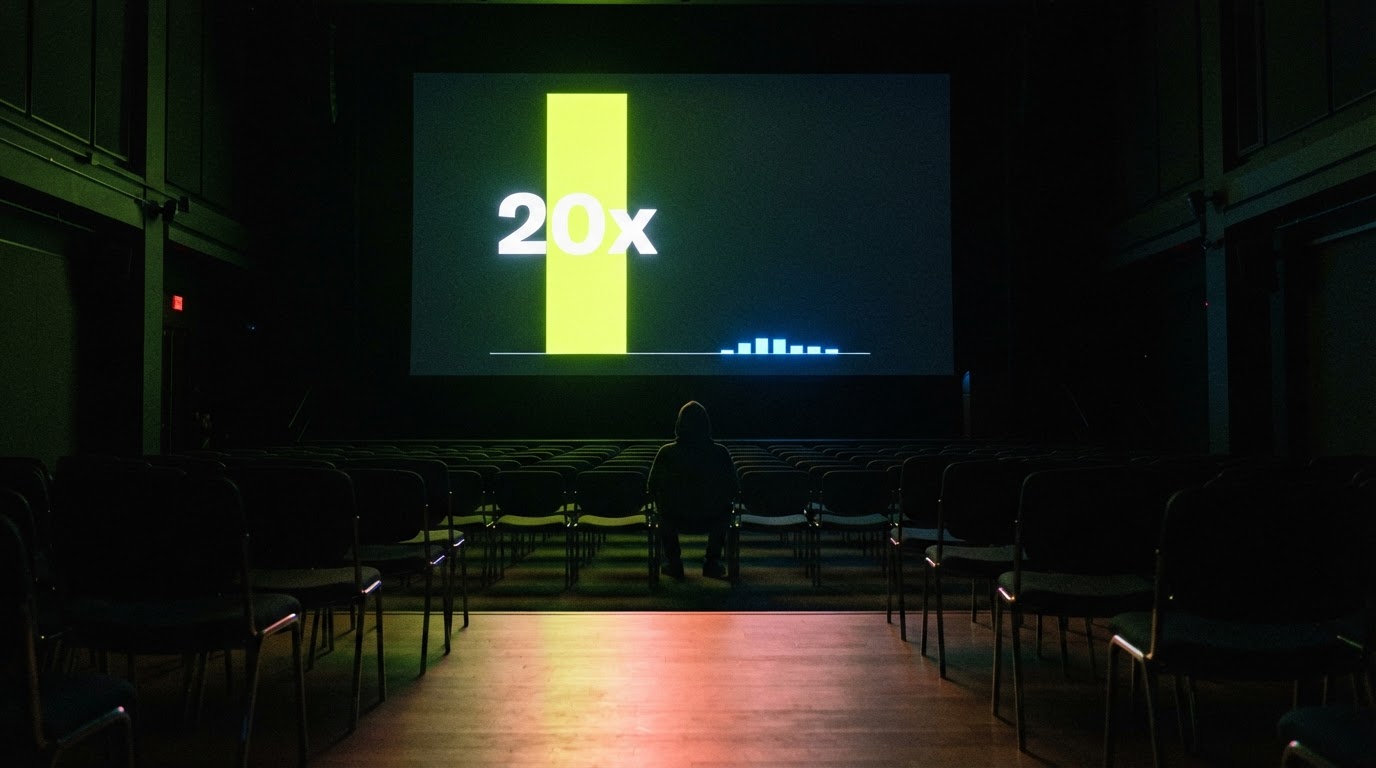
There is a line in Thinkific's Q2 2026 investor deck that every creator paying $49 or $199 a month should read twice.
Plus customers generate monthly ARPU roughly 20 times higher than self-service users, and that gap, the presentation notes, explains management's willingness to accept near-term headwinds in the lower-tier business as it reallocates resources toward enterprise customers.
Read that again slowly. The company hosting your course business has told shareholders, in writing, that it is comfortable losing customers like you because customers like Nasdaq are worth twenty of you.
This is not a leak or a slip. It is the strategy, stated plainly, on a slide.
The 20x number isn't new. The willingness to lose you is.
Thinkific has been quoting the 20x figure for a while. On the Q2 2025 call, management said Plus monthly subscription fees run 20 times self-serve. The Q4 2025 deck repeated it, framing it as the economic rationale for going upmarket.
What changed in Q2 2026 is the other side of the trade finally showing up in the numbers.
Total revenue rose 3% to $18.6 million, above the guided range of $18.2–$18.5 million, with ARPU up 5% to $177 a month. Plus subscription and commerce revenue grew 14% to $5.3 million. Self-serve subscription and commerce revenue decreased 1% to $13.3 million.
That minus sign matters. Self-serve revenue declined 1% year-over-year — the first such drop — attributed to a strategic reduction in customer acquisition spend for lower-value tiers.
Nobody accidentally stops buying ads for a segment. That was a decision.
Subscription revenue overall rose 3% to $15.2 million, with ARR up 2% to $61.7 million. Adjusted EBITDA came in at $273,000, better than guidance for a 2% to 5% loss. Q3 guidance is $18.6 million to $18.9 million — about 1% growth at the midpoint — which the company says reflects continued Plus growth partly offset by ongoing attrition in lower-value self-serve customers.
One percent growth. And the company is telling you why out loud.
The logo slide is the actual message
Here is who Thinkific is now built to impress.
The presentation showcased an expanding roster of enterprise and mid-market customers including a top-25 U.S. bank, Realtor.com, Datadog, Nasdaq, Georgia State University and the University of Oxford, as well as specialized training companies serving regulated industries. Higher education names also included the New York Academy of Art. Marquee wins in the quarter included a top-25 American bank and Ironman.
Those are procurement cycles, security reviews, SOC audits and multi-year contracts. Plus ARPU grew 14% year-over-year, and more than 50% of new Plus deals are multi-year contracts. Plus has compounded at 16% a year from Q2 2023 to Q2 2026, from $2.9 million to $5.3 million.
Credit where it's due: management didn't oversell the trophies. Asked about the bank and Ironman wins, executives said those deals were important validation but not large enough on their own to drive the company's overall ARR profile.
You are still 71% of the revenue
Do the arithmetic the deck doesn't foreground. Self-serve is $13.3 million of $18.6 million — roughly 71% of the quarter. The creators being deprioritised are still funding the pivot aimed at replacing them.
And they're being asked to pay slightly more for the privilege. CFO Leigh Ramsden told analysts there was "a small price increase on self-serve in Q3" and the company is in the early innings of seeing its impact, adding that there is an opportunity to "optimize pricing and packaging across the entire stack."
Less money spent acquiring you. A price nudge on the plan you're already on. That is what optimisation looks like from the other side of the dashboard.
The number nobody is tweeting: GMV is flat
This is the datapoint creators should be arguing about.
For the twelve months ended June 30, 2026, Thinkific generated $75 million in revenue, up 5%, and processed $291 million in gross payments volume, up 20% — while overall gross merchandise volume stayed relatively flat at $456 million.
GMV is the money creators actually make. It didn't grow. Thinkific's payments take of it did.
GPV through Thinkific Commerce grew 10% to $71.4 million, and commerce penetration — GPV as a percent of GMV — hit 67%, up from 58%. Management believes the current feature set has pushed penetration to a plateau in the mid-to-high 60% range.
Translation: the pie stopped growing, so the company took a bigger slice of it. That slice is close to maxed out. Which is exactly why enterprise suddenly looks so attractive.
The fragility of the creator base is also on record. Ramsden said the year-over-year payments decline was driven by a significant customer moving off the platform. On an earlier call, CEO Greg Smith described volatility in self-serve: customers come on, have outsized success, then retire from the business or change their model. One big creator leaving shows up in a public company's quarter. That's how concentrated the top of the creator pyramid really is.
What creators actually get out of this
Not nothing, to be fair.
The rollout of the Thinkific Learner Hub and the Thinker AI teaching assistant is driving engagement, with early adopters reporting a two-times increase in learner completion rates. Completion is the quiet killer of course businesses, and enterprise buyers care about it more than solo creators do — which means solo creators get the enterprise feature roadmap as a side effect.
The product engine got a shake-up too. Thinkific announced the departure of Chief Product and Technology Officer Ryan Donovan on April 15, 2026, with Smith taking direct oversight of R&D. Four months later: "Our R&D team is seeing a dramatic acceleration, delivering more value to customers faster than ever before," Smith said. He told investors the company is "all in on AI."
Why the pressure is real
The market is not applauding yet. The stock last traded at $1.34, unchanged on the day and near the lower end of its 52-week range. Earlier, on July 28, THNC closed at C$1.14, near a 52-week low of C$1.11 and down roughly 31% over the trailing year. Management is targeting low-to-mid single-digit EBITDA margins through the rest of 2026 and double digits in 2027.
That is the whole story in one sentence: a $1.34 stock needs margin, and enterprise contracts carry margin that 35,000 individual subscriptions do not.
Thinkific still reports roughly 35,000 customers, 230 million students served and more than $4 billion earned by customers on the platform. Nobody is getting evicted. But the roadmap, the sales team and the marketing budget now answer to a different customer.
Watch the self-serve line in Q3. If minus 1% becomes minus 3%, the trade-off stops being theoretical.
Sources
- Thinkific Announces First Quarter 2026 Financial Results — Thinkific Investor Relations
- Thinkific Q2 2026 slides show upmarket shift amid modest growth — Investing.com
- Thinkific Q2 2026 slides: upmarket push gains traction — Investing.com
- Thinkific Q2 2026 slides: enterprise push drives 14% Plus growth — Investing.com
- Thinkific Announces Second Quarter 2026 Financial Results — Newswire.ca / Thinkific Labs Inc.
- Earnings call transcript: Thinkific posts modest Q2 2026 revenue beat as upmarket push gains traction — Investing.com
- Q2 2026 Thinkific Labs Inc Earnings Call Transcript — GuruFocus / Refinitiv StreetEvents
- Thinkific Labs Inc (THNCF) (Q2 2026) Earnings Call Highlights — Yahoo Finance
- Thinkific Labs Stock Slides—Can Its AI-Led Product Strategy Power the Next Growth Phase? — Kalkine
- Earnings call transcript: Thinkific Labs Q2 2025 sees revenue growth, AI focus — Investing.com
- Thinkific Q4 2025 slides: upmarket push drives Plus, Commerce growth — Investing.com
Editor’s note: A public company just told shareholders how much less a solo creator is worth than an enterprise buyer — and our readers are the solo creators.