Kajabi's Entry Plan Now Includes Zero AI Credits. Everyone Else Pays $15 Per 500.
A review published this week lays out where Kajabi's repricing actually landed: no Kickstarter tier, a Basic list cap cut by 75%, and AI on a meter.
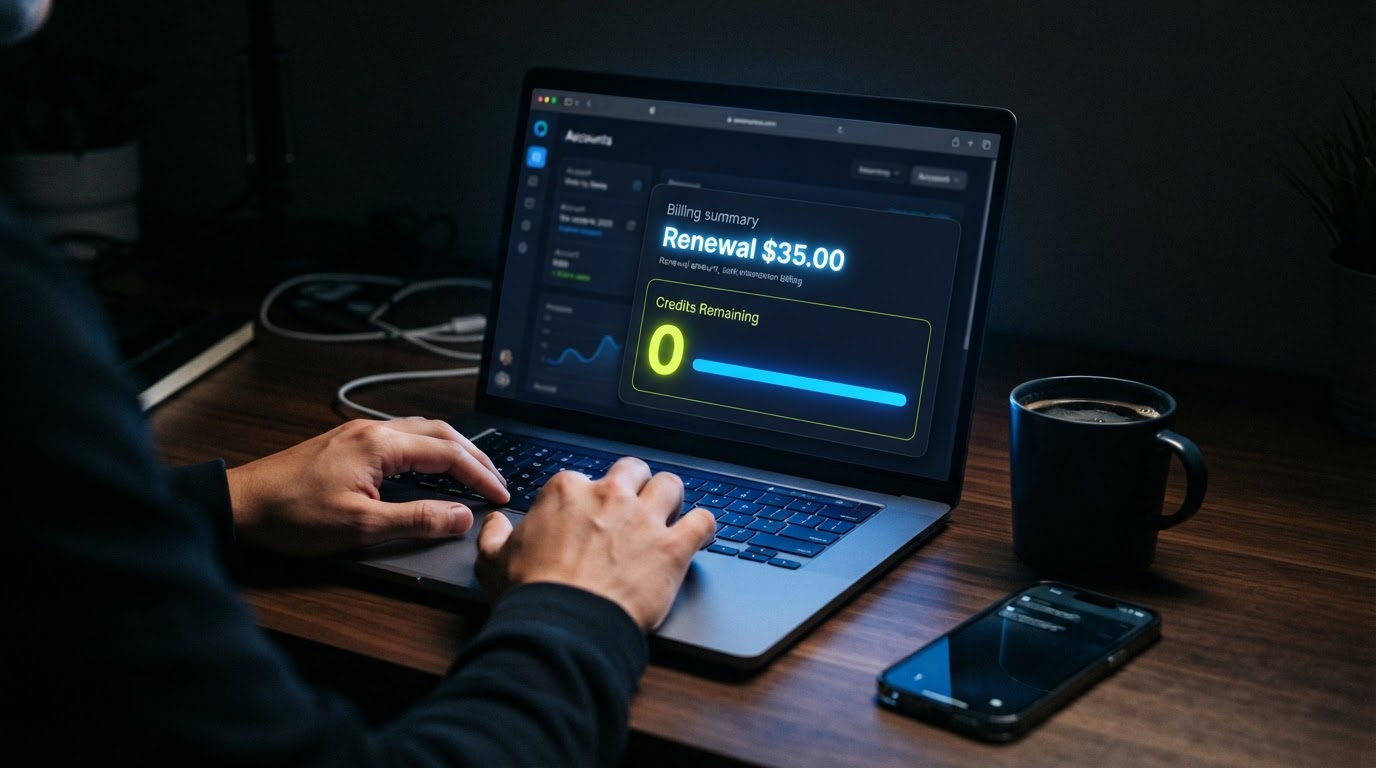
The cheapest Kajabi plan you can buy today comes with no AI credits at all. Not a trial allowance. Zero.
That detail sits inside a Kajabi review published this week by Ruzuku, which pulls together what the platform's 2026 repricing actually did to the people paying for it. Ruzuku is a competing course platform, so treat its framing accordingly. The numbers themselves check out against Kajabi's own published pricing and multiple independent breakdowns.
What changed
Three things, all at once. The Kickstarter plan came off the pricing page — new creators can no longer buy the $89/mo entry plan, though existing Kickstarter accounts kept that price. Prices rose across every tier: Basic +$30/mo, Growth +$50/mo, Pro +$100/mo. And Basic's contact limit dropped from 10,000 to 2,500.
New customers got a 50% promotional discount; existing customers faced the full increase on their first billing date on or after January 13, 2026, with no grandfathered pricing.
The contact cut is the one that bites hardest, because Kajabi counts every lead, subscriber and buyer toward the limit.
A few lead magnets, a webinar and a small launch can push a creator past 2,500 faster than expected.
And unlike email tools that scale in steps, Kajabi forces a plan jump. Ruzuku's own math puts a Basic customer hitting the new cap and getting pushed to Growth at +$1,200 a year.
The AI meter
Here is the part most creators haven't registered. AI inside Kajabi now runs on credits, and the credits are tiered.
None on Basic, 500 a month on Growth, 1,000 on Pro, with extra bundles at $15 a month.
Top-ups cost $15 a month for 500 credits.
Some AI stays open to everyone — Kajabi Cofounder, the in-account chat that answers questions about revenue, targets and products, is on every plan, as is Kajabi MCP, which connects an outside AI to your account. But the credit-funded features are gated, and the cheapest tier is gated out entirely.
What you're actually paying
Basic is $179/month, or $143 on annual billing, with 5 products and 2,500 contacts. Growth is $249/$199 with 50 products and 25,000 contacts. Pro is $499/$399 with unlimited products and 100,000 contacts.
The annual commitments work out to $1,716, $2,388 and $4,788.
For context on how fast this moved: before January 2026, Growth was $159/month annually and Pro was $319.
Check your renewal date
The annual price you signed at is not a price you own. There is no price lock — Kajabi says annual renewals can use its then-current published price, and your next amount appears under Settings > Subscription & Billing before the renewal date.
That's a two-minute check. Worth doing before the invoice does it for you.
Sources
- Kajabi Review 2026: Is It Worth $143/mo? (Honest Pricing & Limits) — Ruzuku
- Kajabi Price Increase 2026: The Math by Plan and Tenure — Ruzuku
- Kajabi Coupon Codes (October 2026): 20% Off — CouponSwift
- Kajabi Pricing (2026) — Learning Revolution
- Kajabi Pricing 2026 (Updated): Which Plan You Actually Need — Tim Peakman
- Kajabi Pricing: Basic, Growth and Pro Compared — Carly
- Kajabi Pricing (2026): Plans, Fees, and What It Really Costs — ThriveCart
- Kajabi Pricing - Is It Too Expensive? — FreshLearn
- Why Kajabi Pricing Tiers Differ: A 2026 Creator's Guide — Sierra Lin Design
Editor’s note: A quiet repricing that caps email lists and meters AI deserves a plain-numbers read — with the competitor-sourced write-up labelled as exactly that.
Keep reading
Everyone Quotes "10 to 20% Completion." The Page That Published It Just Admitted It Has No Source.
The most repeated number in the course business turns out to be an orphan statistic. Here are the three numbers that actually have paperwork behind them.
The Creator Economy Just Hit $217 Billion. Creators Got 42.6% of It.
A new Paris Creator Week study put a number on the whole market — then quietly put a number on how little of it reaches the person making the thing.
Iman Gadzhi's Free Challenge Starts Today. The Number on the Registration Page Is $155 Million.
The AI Income Challenge runs live November 7–15. The FTC has an open proposal that would change what a number like that requires.
Teachers Pay Teachers Went "AI-Free." Its Own Sellers Filed a Petition the Same Day.
Two of the biggest marketplaces for selling knowledge as a digital download decided within two weeks that the AI shortcut now costs more than it saves.